Utah Redistricting Battles: Key Issues to Watch Ahead of 2026 Elections
Utah's redistricting battle intensifies as a court ruling reshapes the political landscape ahead of the 2026 elections.
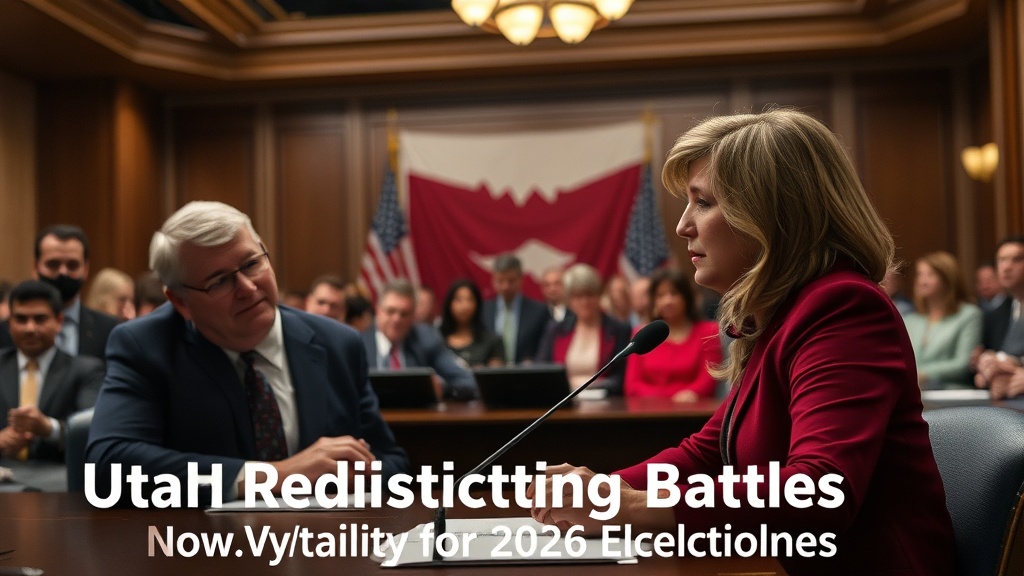
As the political landscape shifts dramatically ahead of the 2026 elections, Utah finds itself embroiled in a contentious redistricting battle that stems from years of litigation over allegations of gerrymandering. In late 2025, a Utah judge ordered the implementation of a new congressional map which has drawn reactions from various political factions across the state. This ruling has significant implications for the future of Utah's political representation, the power of local initiatives, and the ongoing struggle between Republican lawmakers and reform advocates.
The court-ordered map, which includes a Democratic-leaning district primarily situated in northern Salt Lake County, has left many Republican lawmakers frustrated. They argue that the ruling infringes upon the Utah Constitution and the principle of separation of powers. Top Republican leaders have vowed to appeal the decision to the Utah Supreme Court and potentially escalate the matter to the U.S. Supreme Court if necessary. This legal battle is further complicated by the tight timeline, as the legislature has delayed candidate filing deadlines in an attempt to revise the congressional map ahead of the upcoming elections.
In a recent ruling, 3rd District Judge Dianna Gibson acknowledged that the current legal uncertainty casts a shadow over Utah's congressional elections and raises fundamental questions about the redistricting authority. "The Utah Supreme Court can decide now if the Legislature is the sole and exclusive authority over redistricting in Utah or if it shares that responsibility with the people," Gibson stated. This ruling, which disallowed the implementation of the legislature's 2021 map, marks a pivotal moment in the ongoing struggle for electoral fairness in Utah.
At the heart of this redistricting debate is Proposition 4, a voter-approved ballot measure passed in 2018 that initially established an independent commission responsible for drawing congressional maps. However, Republican lawmakers later repealed this law, transitioning the commission to an advisory role that lacked binding authority. This move has incited backlash from anti-gerrymandering groups, who argue that the courts have a duty to intervene when lawmakers fail to uphold the electoral process. The outcome of this legal tug-of-war will have long-lasting ramifications for how Utah's districts are drawn and who gets to decide.
As the political winds shift, the 2026 elections are shaping up to be a critical battleground for both major parties. The newly drawn 1st Congressional District is attracting attention from Democratic candidates eager to capitalize on an opportunity to gain a foothold in a historically Republican stronghold. Notable figures like State Senator Kathleen Riebe and former Congressman Ben McAdams have already declared their candidacies, alongside other prominent Democratic leaders. The crowded primary field reflects the heightened stakes of the upcoming elections, particularly in light of the new congressional map.
Simultaneously, Republican lawmakers are pursuing a ballot initiative aimed at repealing Proposition 4, alongside a potential constitutional amendment to restrict the power of voter-approved initiatives. If successful, this repeal could significantly weaken the mechanisms through which Utahns can influence their government. The groups spearheading this effort face a significant challenge, needing to gather over 140,000 valid signatures by mid-February to place the issue on the 2026 ballot.
The implications of these developments extend beyond redistricting. There are discussions among Republican leaders about possibly expanding the Utah Supreme Court from five to seven justices, ostensibly to expedite the judicial process concerning redistricting and other legislative matters. Governor Spencer Cox has expressed support for this initiative, asserting that it is not an attempt at court-packing but rather a means to enhance judicial efficiency. However, critics argue that such moves reflect a broader trend of legislative frustration with judicial oversight.
As the clock ticks down to the 2026 elections, the fallout from Utah’s redistricting saga will be closely monitored, not just by local observers but also by political analysts nationwide. Voter engagement and public sentiment towards these redistricting efforts will likely play a crucial role in determining the future political landscape of Utah. With a pivotal court ruling pending and the state’s political factions gearing up for a fierce electoral battle, Utah’s redistricting issues represent a microcosm of a larger national debate over electoral integrity and representative democracy.
In summary, the unfolding redistricting conflicts in Utah are poised to reshape the state’s political dynamics considerably. As legislators and citizens alike grapple with the implications of court rulings and proposed reforms, the 2026 elections will serve as a critical test for both parties. Voter engagement and public opinion will undoubtedly play a significant role in determining the outcome of these pivotal issues, making Utah a focal point for discussions on gerrymandering, electoral reform, and the balance of power in state governance.