Pat Bagley: A Pioneer in Political Cartooning at The Salt Lake Tribune
Pat Bagley, a Pulitzer finalist, shapes political discourse in Utah through his impactful cartoons.
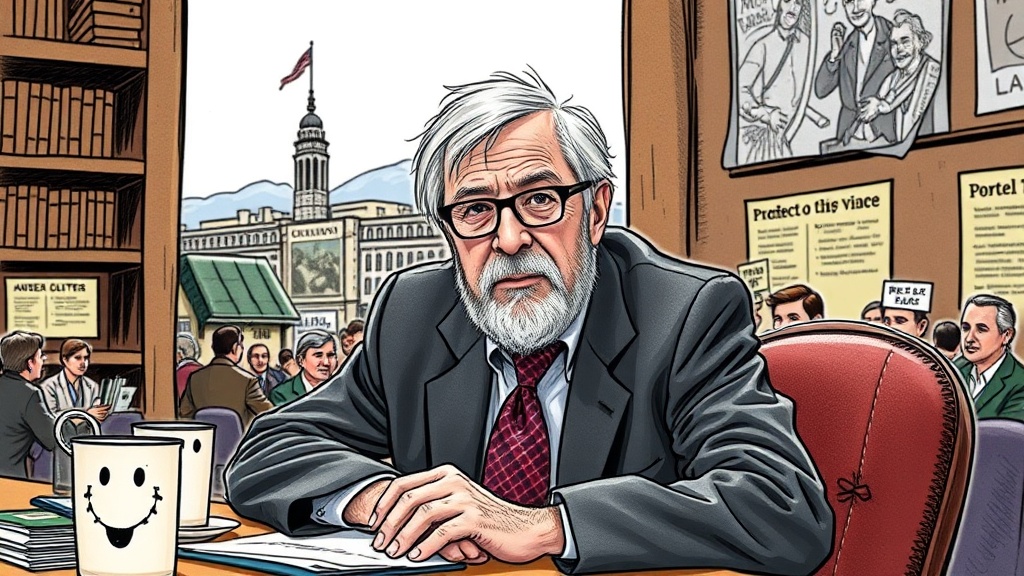
In a world where political commentary often takes the form of Tweets, Pat Bagley stands out as a bastion of traditional editorial cartooning. With a career spanning over 45 years at The Salt Lake Tribune, Bagley has not only shaped public discourse in Utah but has also established himself as a significant voice in American political cartooning. His work has garnered national recognition, including being a finalist for the prestigious Pulitzer Prize in the cartoonist category, underscoring the impact of his satirical artistry on both local and national stages.
Born in Los Angeles, California, Bagley discovered his passion for cartooning at a young age. After earning a degree in Fine Arts from the University of Utah, he began his career at The Salt Lake Tribune in 1975. Since then, he has witnessed, and often illustrated, the seismic shifts in political landscapes both within Utah and across the United States. His cartoons tackle complex issues ranging from local governance to national crises, often with a sharp wit that resonates with readers.
Bagley’s distinctive style combines bold lines and clever visual metaphors, allowing him to convey powerful messages with brevity. His work often reflects the pulse of the community, addressing the concerns and sentiments of the people. "Cartoons can distill complex ideas into something that is easily digestible," Bagley explained in a recent interview. "In a world overflowing with information, the ability to convey a message quickly is more important than ever."
Throughout his career, Bagley has not shied away from controversial topics. From critiquing state policies on education and healthcare to commenting on national figures and events, his cartoons often spark discussions that extend beyond the pages of the newspaper. One notable piece criticized Utah's handling of public health during the COVID-19 pandemic, illustrating the tension between government officials and public health experts. The cartoon not only caught the eye of readers but also prompted conversations in local media about the state’s response to the crisis.
Despite the challenges faced by print media today, Bagley remains committed to his craft. As one of roughly a dozen editorial cartoonists still actively working at major metropolitan newspapers in the United States, he is keenly aware of the changing landscape of journalism. "The digital age has transformed how people consume news, but there is something irreplaceable about holding a printed cartoon in your hands," he noted. His work continues to be a staple in the Tribune, providing a unique perspective that complements traditional reporting.
The role of editorial cartoonists like Bagley is more essential than ever in a time of polarization and misinformation. As audiences increasingly turn to social media for news, the ability to provide context and critique through satire can help clarify public discourse. Bagley’s cartoons serve as a reminder of the importance of critical thinking, encouraging readers to question the narratives presented to them, both in media and politics.
Bagley’s influence extends beyond the boundaries of Utah. His cartoons have been featured in various national publications, including The New York Times and USA Today, establishing him as a significant figure in political commentary. His work has inspired a new generation of cartoonists who are navigating the complexities of modern politics and social issues.
In addition to his editorial work, Bagley has also been involved in various community initiatives aimed at promoting the arts. He has conducted workshops and talks to encourage young artists and aspiring cartoonists to explore their craft. "Art has the power to provoke thought and inspire change," he stated. "I hope to instill that belief in the next generation."
As he continues to produce his insightful cartoons, Bagley reflects on the evolution of his art. "Every era has its challenges, and every cartoon reflects the time it was created in," he remarked. His ability to adapt while remaining true to his artistic vision is a testament to his talent and dedication.
Looking ahead, Bagley is optimistic about the future of editorial cartooning, despite the hurdles posed by digital media. "If anything, the need for satire and critique is more important now than ever. I believe that there will always be a place for good cartoons that challenge the status quo," he concluded.
In a time where many voices compete for attention, Pat Bagley’s work stands as a significant contribution to both local and national conversations, reminding us of the power of art to reflect, critique, and inspire. As he continues to draw and engage with issues impacting society, his legacy as a leading figure in editorial cartooning is firmly cemented in the annals of American journalism.