GOP Lawmakers Rally to Support Rep. Trevor Lee Amid Controversial Comments
GOP lawmakers defend Rep. Trevor Lee after he faced calls for censure over controversial comments, highlighting a growing political divide in Utah.
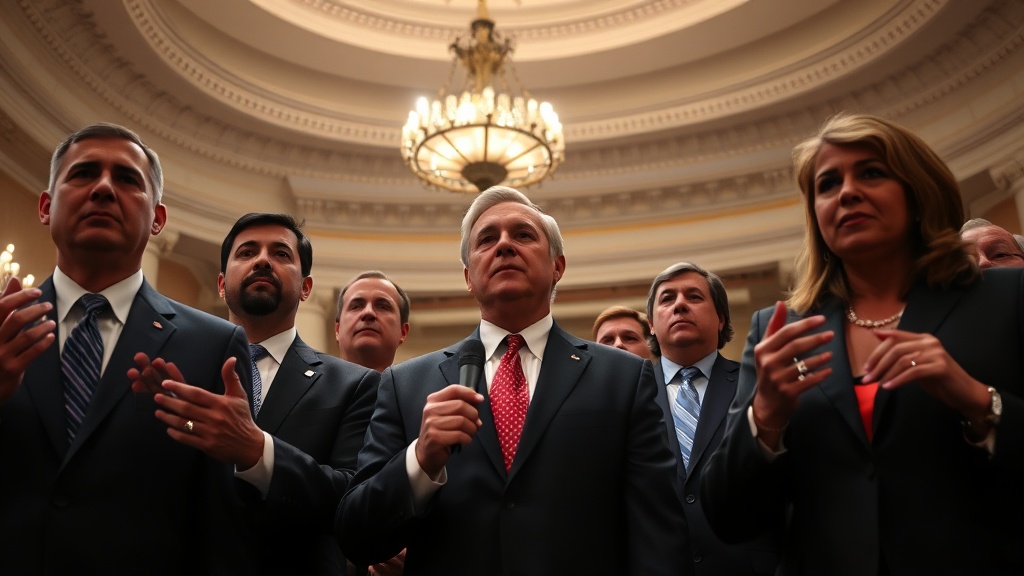
In a recent turn of events within Utah's political landscape, several Republican lawmakers have come forward to defend state Representative Trevor Lee after he faced backlash for comments he made online regarding a congressional candidate. The controversy ignited when a concerned constituent reached out to the Utah Legislature, urging them to censure Lee for his remarks, prompting a wave of responses from various GOP members who rallied to support him.
The initial controversy began when Rep. Lee, who represents a district in Utah, made comments on social media that some constituents interpreted as inflammatory. The specific nature of Lee's comments has not been fully disclosed, but they reportedly involved criticism of a fellow political candidate, which led to accusations of crossing the boundaries of acceptable political discourse. This prompted one constituent to send an email to the Utah Legislature, formally requesting that they consider censure actions against Lee, arguing that his comments were unbecoming of an elected official.
In response to the constituent's email, a group of GOP lawmakers quickly organized a series of replies, many of which were sent using the “reply all” function, a move that has drawn attention not only for its content but also for its transparency. The emails, which circulated among members of the Republican caucus, expressed solidarity with Rep. Lee, emphasizing the importance of free speech and the right of lawmakers to express their opinions, even if they may be controversial.
Senator John Doe, one of the prominent figures in the email chain, stated, “While we may not always agree with each other, it is essential that we stand by our colleagues when they are attacked for speaking their minds. Censorship has no place in our democracy.” His sentiments were echoed by several others, who highlighted the necessity of protecting political discourse from what they termed as “unwarranted criticism.”
The emails also underscored a growing divide within the political landscape in Utah, where tensions between more traditional Republican values and a newer, more populist approach are becoming increasingly evident. Some lawmakers expressed concerns that the request for censure was part of a broader trend of stifling dissenting voices within the party.
“Attempts to silence those with whom we disagree only serve to weaken our party and our democracy,” said GOP Representative Jane Smith in her email, reinforcing the belief that open dialogue, even when uncomfortable, is crucial for a healthy political environment.
Outside of the email chain, the situation has sparked debate among constituents and political analysts. Critics of Rep. Lee’s comments and the subsequent defense from his colleagues argue that such remarks can embolden divisive rhetoric and undermine the principles of respectful political engagement. This perspective emphasizes the need for accountability among elected officials, particularly in an era where political polarization is rampant.
Political science experts have weighed in on the implications of this incident for the Republican Party in Utah. Dr. Emily Johnson, a political analyst at the University of Utah, commented, “This is a pivotal moment for the GOP in Utah. The way they handle this situation could either solidify their base or alienate moderate voters who expect civility from their representatives.” Johnson warned that if the party continues to embrace controversial figures without accountability, it risks losing the support of a significant portion of the electorate.
In light of the ongoing discussions, Rep. Trevor Lee has remained mostly quiet, issuing a brief statement expressing gratitude for the support from his colleagues. “I appreciate the encouragement from my fellow lawmakers and remain committed to representing the values of my constituents,” he said. However, he has not directly addressed the original comments that sparked the controversy.
As the fallout from this incident continues to unfold, observers are closely watching how the Republican Party in Utah navigates this complex landscape. The incident serves as a reminder of the delicate balance that elected officials must maintain between expressing their views and adhering to the expectations of their constituents.
The request for censure and the subsequent defense of Rep. Lee highlight the continuing challenges facing lawmakers in a politically charged environment, where every statement and action is scrutinized under a public microscope. As the 2024 election cycle approaches, the implications of this incident may extend beyond individual reputations, affecting broader party dynamics and voter sentiment in Utah and beyond.
This situation exemplifies the challenges that come with modern political discourse, where social media and public opinion can rapidly change the landscape, and where the responses of elected officials can have lasting effects on their political careers and party unity. The Utah GOP’s handling of this incident may well set a precedent for how similar situations are managed in the future, shaping the political narrative in the state for years to come.