UVU Students Stage Sit-In Against Border Patrol Recruitment at Career Fair
UVU students protested CBP recruitment at a career fair, expressing concerns over immigration enforcement and advocating for open dialogue.
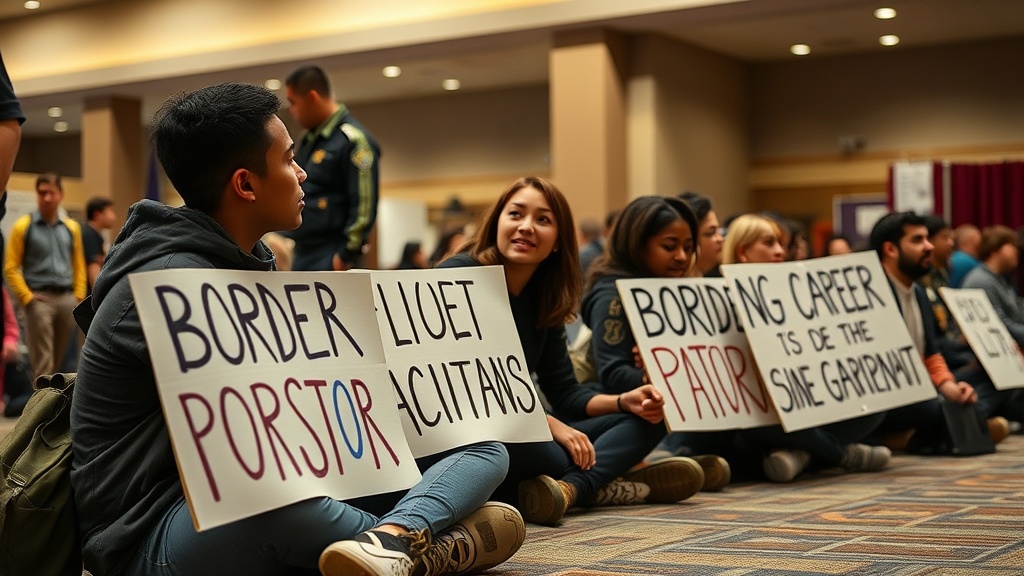
OREM, Utah – A group of students at Utah Valley University (UVU) took a stand against federal immigration enforcement recruiting efforts on campus by organizing a sit-in protest during the university's Career and Internship Fair on Thursday. The protest was spearheaded by the university's Civil Disobedience Club, which positioned themselves outside the Grand Ballroom where the fair was held to voice their disapproval of the presence of Customs and Border Protection (CBP), a division of the Department of Homeland Security (DHS).
The Career and Internship Fair, which started at 10 a.m., was intended to connect students with potential employers. However, the participation of DHS raised concerns among students about the agency's controversial practices, particularly regarding immigration enforcement. The protesters held signs and chanted slogans like "ICE off campus," conveying their demand for the university to cease any collaboration with immigration enforcement agencies.
Jack McNiven, one of the presidents of the Civil Disobedience Club, articulated the group's stance, stating, "We want to express our disapproval with DHS as an agency, their illegal actions right now. We just want to express to the university and community that we aren't okay with it." The protest was a response to what students see as a shifting political climate surrounding immigration policy and enforcement in the United States.
Harper McGee, another president of the club, echoed these sentiments, emphasizing that the context of CBP's recruitment efforts had changed significantly compared to previous years. "The context is totally different right now, and they are doing different things. The political atmosphere is completely different," she stressed. The students' concerns stem from recent reports of aggressive immigration practices and the broader implications these have on their community and fellow students.
Prior to entering the fair, attendees were required to pass through security detectors and undergo bag searches, a process that some students found disconcerting. Alexander Draper, a student who attended the fair, expressed his concern about the future of recruitment by agencies like CBP on campus. "We want to make sure that doesn't happen, and we want the Career and Internship Center to not invite or welcome them back on campus ever," he said.
The university administration responded to the protest by issuing a statement acknowledging the concerns raised by the campus community. "UVU is aware of campus community concerns related to the upcoming internship and career fair. Consistent with our freedom of speech policies, participating employers have the right to advertise opportunities on campus. The university is coordinating with campus safety and event organizers to facilitate a secure and respectful environment for all attendees," the statement read.
The protest highlights a growing trend among college students nationwide who are increasingly vocal about social justice issues, particularly those related to immigration and human rights. Draper emphasized the need for open dialogue on such topics, stating, "People are afraid to talk about their opinions. That's the antithesis of what college is about, and I like the idea of people who can communicate."
The sit-in protest at UVU is part of a larger movement among students advocating for policies that align more closely with their values on social justice and equality. As universities continue to serve as platforms for discussions on pressing societal issues, the actions taken by UVU students exemplify how young people are mobilizing to influence the institutions they are a part of.
As the nation grapples with divisive immigration policies, the voices of students like those at UVU are increasingly important. Their actions not only reflect their personal convictions but also serve as a call to other educational institutions to consider the implications of allowing certain organizations to recruit on campus. The outcome of this protest may influence future policies at UVU and beyond, as students demand more accountability from their universities in their partnerships with federal agencies.
The protest concluded without incident, but it left a lasting impression on attendees and university officials alike, sparking conversations about the role of educational institutions in shaping societal values and the importance of fostering an inclusive environment for all students. As students continue to advocate for change, the implications of their actions may reverberate well beyond the walls of their university, influencing broader conversations around immigration, recruitment, and social justice in America.