Utah Leaders Mobilize to Restore the Great Salt Lake Ahead of 2034 Olympics
Utah state officials are mobilizing efforts to restore the Great Salt Lake ahead of the 2034 Winter Olympics, emphasizing the need for sustainable water management.
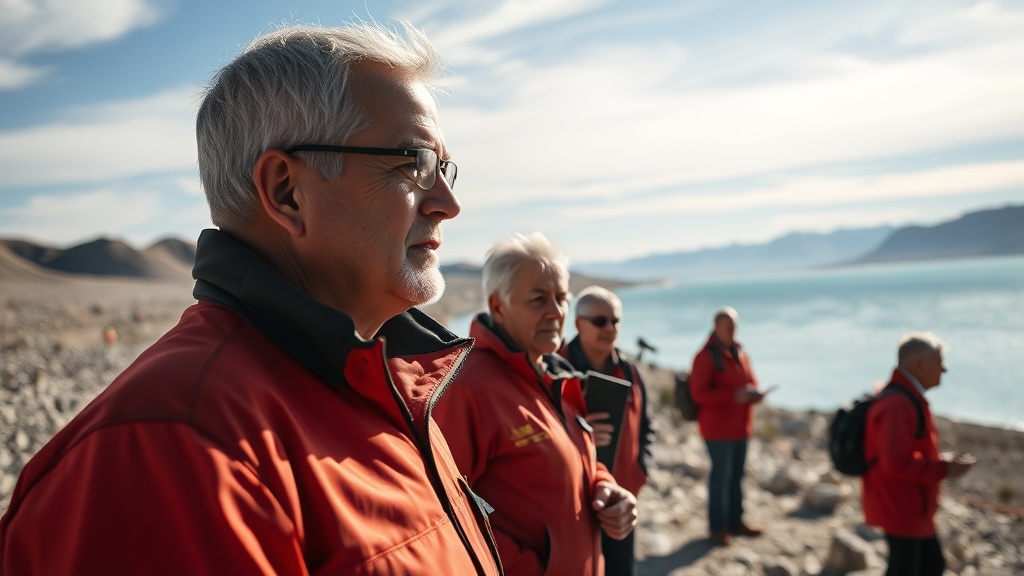
In a concerted effort to revitalize the Great Salt Lake, state leaders in Utah have unveiled ambitious plans aimed at addressing the alarming decline of this vital ecosystem. The lake has shrunk significantly in recent years due to a combination of drought, climate change, and the diversion of water for agricultural and industrial purposes. As the state gears up for the 2034 Winter Olympics, officials are keen to harness this global spotlight to draw attention to the lake's plight and mobilize resources for its recovery.
Brian Steed, the Great Salt Lake commissioner, emphasized the importance of collective action at a recent event hosted by the University of Utah’s Kem C. Gardner Policy Institute. “Yes, our choices do matter when it comes to this lake, and those choices can actually increase recovery, and the speed of recovery,” he stated, highlighting the need for community engagement and responsible water management. Steed, along with the state’s “Great Salt Lake strike team” — a coalition of water experts, government officials, and stakeholders — presented a report detailing recent milestones, water usage data, and actionable steps to restore the lake's health.
The Great Salt Lake has reached alarming low levels, including a record low in 2022, and has struggled to maintain stable water levels, ending 2025 at the third-lowest point since 1903. This decline is particularly concerning given that agriculture accounts for 65% of water usage in the Great Salt Lake Basin, followed by municipal and industrial use at 26.8%, and mineral extraction at 5.7%. The challenges posed by these water allocation practices are central to discussions around the lake’s future and the sustainability of Utah's water resources.
Natalie Gochnour, director of the Gardner Institute, noted that the upcoming Olympics could serve as a catalyst for change. “We know that in 2034, the world’s eyes are going to be on this state. And we’ve made this commitment, we’ve signed this charter for the lake, to commit ourselves to be the place that rescues an inland sea,” she remarked, urging for a collaborative approach to tackle the water crisis.
To support these efforts, the state has secured significant funding from various sources. Notably, the U.S. Bureau of Reclamation has contributed $50 million, while conservation nonprofit Ducks Unlimited has pledged an additional $100 million. Furthermore, a philanthropic campaign known as Great Salt Lake Rising has also committed $100 million to aid in the recovery initiatives. These financial commitments reflect a growing awareness of the lake's ecological and economic significance.
However, challenges remain. Timothy Hawkes, representative of the Great Salt Lake Brine Shrimp Cooperative, expressed cautious optimism regarding the funding influx but raised a critical question: “How are you actually going to get that much water to the lake?” His concerns highlight the complexity and slow progress of implementing effective water management solutions.
In response to air quality concerns exacerbated by the lake’s receding shoreline, Kevin Perry, an atmospheric sciences professor at the University of Utah, revealed that the state is enhancing its monitoring systems to track the frequency and severity of dust storms that can carry harmful toxins from the dry lakebed. “I was super excited about this because this is the first time that the state has really taken the dust issue seriously,” Perry remarked, acknowledging the importance of addressing public health risks associated with environmental degradation.
The report from the strike team also pointed to some successes in conservation efforts over the past 25 years, noting that annual average inflow to the lake has increased by 1,665 acre-feet, equivalent to over 830 Olympic-sized swimming pools. Anna McEntire, managing director of Utah State University’s Janet Quinney Lawson Institute for Land, Water and Air, expressed confidence that this trend could continue. “I’m really confident this is a case of increasing returns,” she noted, emphasizing the potential for further improvements in water conservation.
In terms of household water consumption, most usage occurs outdoors, primarily for lawns and gardens, rather than for indoor activities such as cooking and bathing. McEntire pointed out that reducing outdoor water use could significantly contribute to water conservation efforts in the region.
Joel Ferry, executive director of the Utah Department of Natural Resources, called 2026 a “watershed year” for water management in the state. He has been working closely with lawmakers and agricultural officials to expand a program that financially compensates farmers for conserving water by fallowing fields. During discussions at the recent event, Ferry expressed optimism for transformative changes in water use practices.
As Utah faces the dual challenges of preparing for the Winter Olympics and addressing the ecological crisis of the Great Salt Lake, state leaders are determined to leverage public awareness and financial investments to restore this critical natural resource. The collective commitment from various sectors underscores the urgency of action as the clock ticks down to 2034, with hopes of not only saving the lake but also setting a precedent for sustainable water management in the face of climate change.