Morgan Scalley Steps Up Amid Transition at Utah Football Program
Morgan Scalley steps into the head coaching role at Utah, aiming for continuity amid challenges following Kyle Whittingham's retirement.

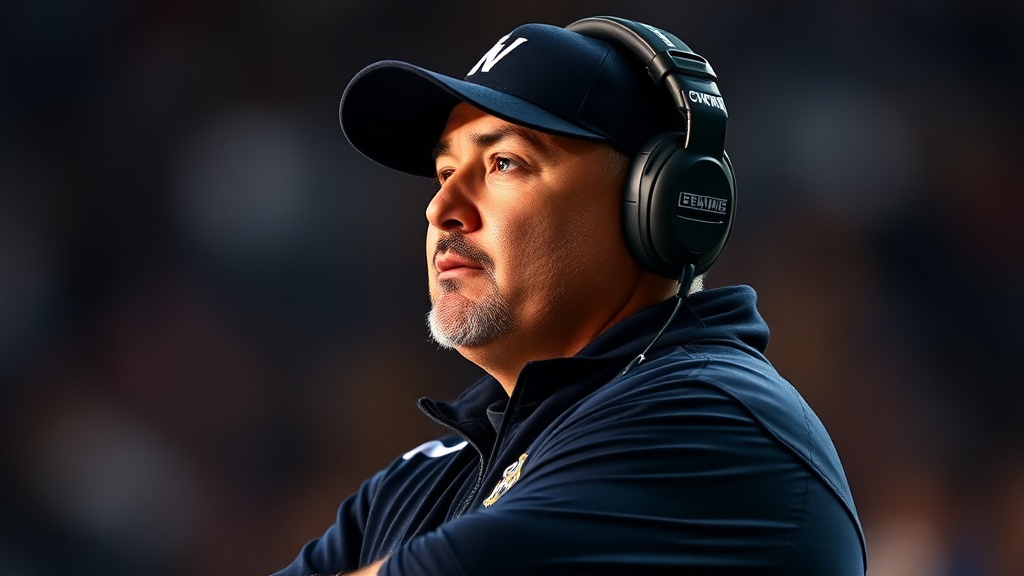
SALT LAKE CITY (AP) – The Utah Utes football program is navigating a pivotal transition as Morgan Scalley takes the reins following the retirement of legendary coach Kyle Whittingham. Having served as the coach-in-waiting for the past two seasons, Scalley was expected to lead a seamless transition. However, the unexpected hiring of Whittingham by Michigan on December 26 left Scalley with significant challenges, including filling key coaching positions and maintaining team morale among players and recruits.
At his introductory press conference, Scalley humorously likened the experience to giving birth to twins, highlighting the influx of new faces in the coaching staff. "I feel like it's my first birth and I (had) twins," he joked, acknowledging the magnitude of the changes within the program. Scalley has since been focused on building a competent coaching staff, successfully hiring multiple coordinators and assistants to ensure continuity and maintain the competitive edge that Utah has enjoyed in recent seasons.
Scalley’s coaching philosophy emphasizes a rapid establishment of offensive identity, a strategy he believes is essential for the success of young athletes. He has prioritized continuity within the offensive structure, bringing in offensive coordinator Kevin McGiven, who previously guided a similar offensive scheme at Utah State. This approach aims to preserve the high-flying offensive style that was successful under former coordinator Jason Beck during the 2025 season. "There has to be a system where you can teach these young men quickly and get an offensive identity established early," Scalley noted. He is optimistic about leveraging the existing talent on the roster that is already familiar with the offensive concepts.
During his 10-year tenure as Utah’s defensive coordinator under Whittingham, Scalley built a reputation for developing a formidable defense. Over the last decade, Utah consistently ranked among the top half of the Pac-12 in total defense, finishing in the top 20 nationally in various defensive metrics including passing efficiency and scoring defense. The 2019 season was particularly notable, with Scalley’s defense ranking second in the nation and first in the Pac-12 in total defense. In 2025, his unit allowed an average of just 18.7 points per game and recorded 14 interceptions.
Mark Harlan, Utah’s athletic director, expressed confidence in Scalley’s ability to lead the program, stating, “He has proven over and over again that he is not only prepared and ready to lead but will excel in taking over our storied football program.” Scalley’s deep-rooted connection to the university is evident; he played safety for the Utes from 2001 to 2004, earning accolades such as the Mountain West Co-Defensive Player of the Year and a second-team AP All-American designation during his senior year. His loyalty to the program has been unwavering, as he turned down multiple coaching opportunities at other institutions to remain in Salt Lake City.
“I never wanted to leave here. My family is here, and I never wanted to uproot that,” Scalley stated. His steadfast commitment to the Utes has fostered a perception that Whittingham’s retirement was influenced by a desire to keep Scalley from pursuing opportunities elsewhere. Harlan emphasized the healthy dialogue he and Whittingham shared regarding the future of the program, asserting that Whittingham felt at ease leaving the program in Scalley’s capable hands. “He did not want to use the word retirement and I understood what that meant. He might go coach again,” Harlan explained.
As Scalley embarks on this new chapter, the implications for the Utes are significant. The program has established itself as a competitive force in college football, and maintaining that momentum will be critical in the wake of Whittingham’s departure. With a solid foundation in place and a commitment to continuity, Scalley is poised to lead Utah into a new era while honoring the legacy of his predecessor. As the 2026 season approaches, the Utes and their loyal fanbase are eager to see how Scalley’s vision unfolds on the field. The upcoming recruiting cycle, roster retention, and staff cohesion will be vital factors in determining the program’s success in this transitional phase.
In conclusion, while the transition may have faced unforeseen hurdles, Morgan Scalley’s dedication to the Utah football program and his strategic approach to coaching offer a promising outlook for the Utes as they prepare for a future under new leadership.