Wasatch County Judges Host Town Hall to Engage Community on Key Legal Issues
Wasatch County judges engage with residents at a town hall, addressing legal questions and community concerns to foster public trust.
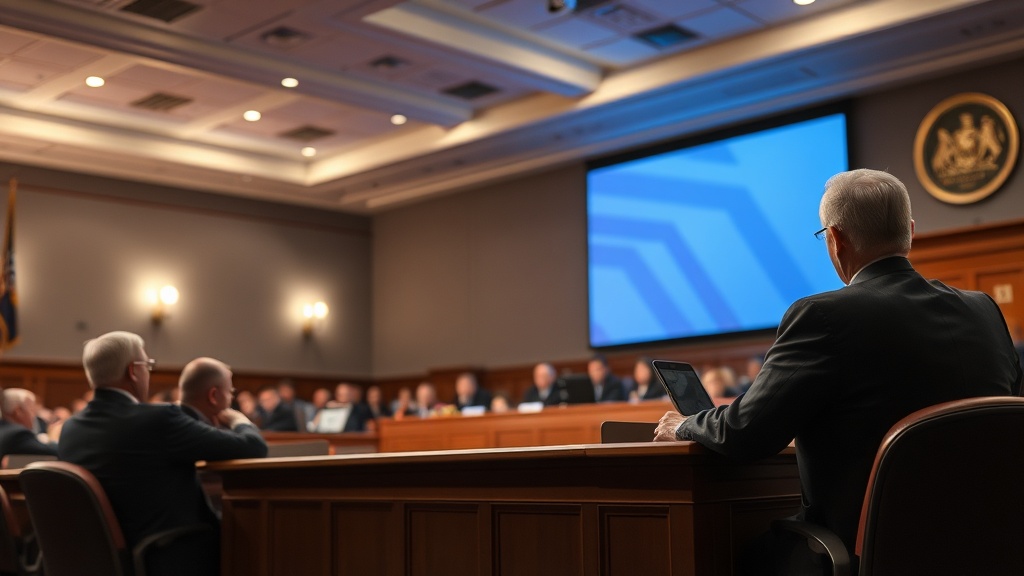
In a proactive effort to bridge the gap between the judiciary and the citizens of Wasatch County, local judges held a Court Connect town hall at the Wasatch County Justice Court on Thursday. This initiative, which first launched in Tooele County in November, aims to foster public trust through open dialogue and transparency regarding court operations and pressing legal matters.
Jonathan Puente, the director of the Office of Fairness, Equity and Accountability for Utah State Courts, emphasized the importance of building relationships in a time when public trust in institutions is waning. "Right now is a time where most folks don’t trust institutions. If you want to build trust, it’s relationships. And in order to have relationships, it’s about communicating," Puente stated. The Court Connect initiative is part of a broader strategy to engage communities, allowing residents to ask questions directly to judges and court personnel, thereby demystifying the judicial process.
The event featured a panel of esteemed judges, including Fourth District Court Judge Jennifer Mabey, Fourth District Juvenile Court Judge Brent Bartholomew, Heber City Justice Court Judge Randy Birch, and Wasatch County Justice Court Judge Brook Sessions. The format largely consisted of a question-and-answer session, which provided attendees with an opportunity to voice their concerns and clarify misconceptions about the legal system.
One attendee raised an interesting inquiry about the seemingly random selection for jury duty, questioning why they had been called multiple times while their spouse had never been summoned. Judge Mabey humorously addressed the question by likening the situation to a lottery, noting, "You hear stories of someone winning the lottery twice. Like, how does that happen? But our system is designed to be random because that ensures that jurors are not picked based upon any particular attribute." This response was met with laughter from the audience, illustrating the judges' approachable demeanor.
Another pressing question centered on crime trends in Wasatch County, prompting Judge Birch to provide statistical insights. He reported that his court had dealt with approximately 3,600 cases in 2012, a number that has decreased significantly to around 2,327 projected for 2025. However, Birch noted that he has seen no direct correlation between crime rates and population growth in the area. "The other weird thing? Heber is sort of like this 'Crossy Road' mecca in the summer, right? You’d think we’d have more cases in the summer. Our slowest months for tickets are June, July, and August," he explained.
Judge Mabey also provided insights into recent felony filings, indicating a decline from 196 in 2024 to 147 in 2025, while misdemeanor DUI cases have remained persistently high. This observation highlights ongoing challenges in the community regarding substance abuse and public safety, an issue that the judges acknowledged with concern.
A significant portion of the discussion revolved around the implications of artificial intelligence (AI) within the legal framework. Judge Mabey shared her experiences with AI-generated pleadings, noting that they often contain inaccuracies, referred to as "hallucinations," where nonexistent cases are cited. "One of the things that we see is that there are hallucinations in those pleadings. You have to have case law to support what you’re asking for, but sometimes the case law that’s being cited is not an actual case," she explained. Furthermore, Judge Mabey expressed her concerns about deepfakes, particularly in sensitive cases such as domestic disputes, where the authenticity of digital evidence can be difficult to ascertain.
Judge Sessions added to the discussion by highlighting the challenges courts face in navigating established evidentiary rules while adapting to advancements in technology. "We’re trying to run our courts with the old rules of evidence in the new world of AI. And it’s a challenge every day that I expect is going to get harder," he stated, underlining the urgent need for the legal system to evolve alongside technological advancements.
Immigration issues were also addressed, as Judge Mabey discussed the complexities surrounding immigration holds and their impact on court proceedings. "The difficulty with that is that if they do go into ICE custody, I’m probably not going to see them again. So, I will have cases that don’t get resolved because they are gone from the jurisdiction," she noted.
Judge Birch recounted a particularly troubling incident where immigration authorities disrupted a court session, which illustrated the real-world implications of such actions on community trust and participation. "I would never obstruct immigration from coming into my courtroom, but I really don’t like it when they do. It makes it a little hard to get people to come deal with their tickets when that happens," he remarked.
As the event drew to a close, Judge Mabey encouraged attendees to complete a survey regarding future topics for Court Connect sessions. Many responses suggested a desire for discussions on domestic violence, prevention of common offenses, and resources for legal assistance. "We’re all trying to figure out how to do what we do better, to serve our communities better, to uphold the oaths that we’ve taken as judges," Judge Mabey stated, reflecting the judges' commitment to continuous improvement in their service to the public.
The next Court Connect event is scheduled to take place at the Matheson Courthouse in Salt Lake City on Wednesday from 4 to 6 p.m., promising further opportunities for community engagement and dialogue between the judiciary and the public. This initiative represents a vital step toward enhancing transparency and trust in the legal system in Wasatch County and beyond.