Nicolás Maduro Maintains Innocence Amid Federal Drug Trafficking Charges
Nicolás Maduro, facing federal drug trafficking charges, maintains his innocence in a defiant court appearance, claiming political persecution.
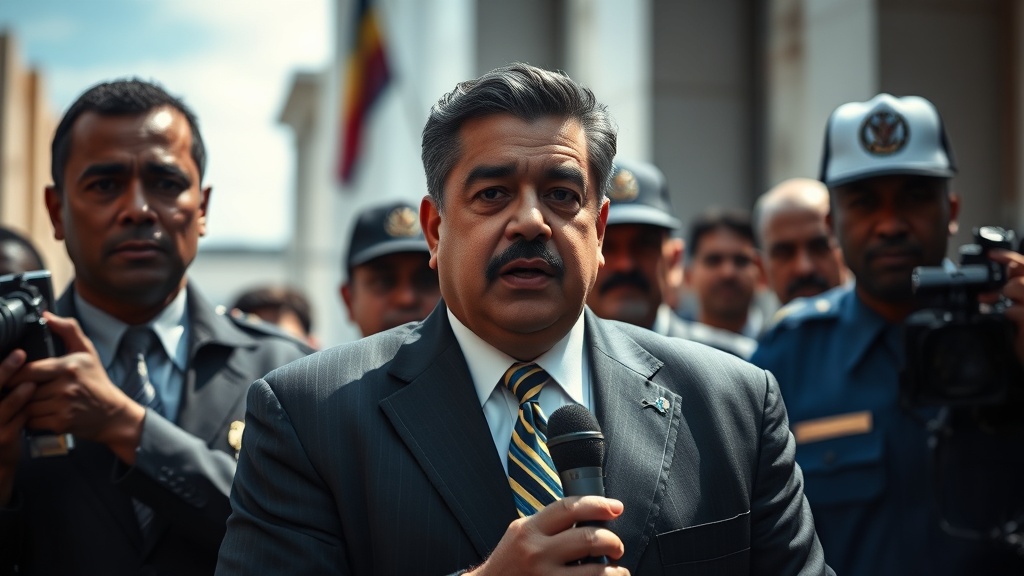
Nicolás Maduro, the former president of Venezuela, appeared in court on Monday, striking a defiant tone as he faced serious federal drug trafficking charges. In a courtroom filled with reporters and legal personnel, Maduro maintained his innocence, insisting that he was a victim rather than a perpetrator in the international drug trade. His bold proclamation came as he pleaded not guilty to the charges brought against him by U.S. authorities, which accuse him of leading a vast drug trafficking scheme that has allegedly flooded the United States with narcotics.
During the court proceedings, Maduro expressed his frustration with the legal process. "I was captured," he declared in Spanish, though his statement was abruptly interrupted by the presiding judge, who sought to maintain order in the courtroom. According to a translation provided by a courtroom reporter, Maduro's comment was part of a broader attempt to assert that he was a target of political persecution, a narrative he has consistently promoted since he was ousted from power.
The charges against Maduro stem from an indictment unsealed in March 2020, which accused him and several high-ranking Venezuelan officials of conspiring to traffic cocaine into the U.S. The indictment alleges that Maduro collaborated with Colombian guerrilla group FARC to use Venezuela as a key transit point for drug shipments aimed at U.S. markets. U.S. officials have labeled Maduro a "narco-terrorist," reflecting the gravity of the allegations.
In the courtroom, Maduro’s demeanor was resolute as he addressed the judge and the assembled crowd. He reiterated his claims of innocence and accused the U.S. government of engaging in a politically motivated campaign to undermine his leadership and destabilize Venezuela. "I am here to defend my honor and my name," he asserted. His statements echoed previous remarks made in interviews, where he characterized the charges as baseless and driven by the U.S.'s long-standing animosity toward his socialist government.
The U.S. has made significant efforts to capture Maduro since the charges were filed. In 2020, the Trump administration announced a $15 million reward for information leading to his arrest. The urgency surrounding the pursuit of Maduro reflects both the U.S.'s focus on combating drug trafficking and its broader geopolitical strategy in Latin America. Maduro's government, which has faced multiple crises, including economic collapse and widespread protests, has often pointed to external enemies, particularly the U.S., as scapegoats for its troubles.
In recent years, diplomatic relations between Venezuela and the United States have deteriorated sharply. The U.S. has imposed a series of sanctions targeting Maduro and his inner circle, aimed at crippling their economic resources. These measures have exacerbated Venezuela's already dire economic situation, leading to hyperinflation, food shortages, and mass emigration. Maduro's court appearance thus not only serves as a legal battle but also highlights the ongoing struggle for legitimacy and power in a country embroiled in a humanitarian crisis.
As the proceedings unfolded, observers noted that Maduro's courtroom strategy appears to be one of defiance and resilience. The former president's refusal to accept culpability aligns with his longstanding narrative of victimhood against perceived foreign aggression. His supporters view him as a champion of resistance against U.S. imperialism, while his detractors argue that his regime is responsible for widespread human rights violations and corruption.
Legal experts have speculated on the implications of Maduro's case for international law and U.S.-Venezuela relations. Should he be extradited to the U.S., it would set a precedent for how foreign leaders accused of drug trafficking are treated under international law. Furthermore, it could complicate any potential diplomatic negotiations aimed at resolving the ongoing political crisis in Venezuela.
As the court date concluded, Maduro's legal team prepared to defend against the allegations, while the prosecution emphasized the seriousness of the charges. The next steps in the judicial process remain uncertain, but this case is expected to unfold over the coming months, drawing attention from both domestic and international audiences.
In a world where drug trafficking poses significant challenges to public health and safety, Maduro's trial will be closely monitored as it may reveal insights into the intersection of politics, crime, and justice on a global scale. As he continues to fight the charges, the implications of this case extend beyond the courtroom, touching on issues of sovereignty, international relations, and the ongoing struggle for power in Venezuela.