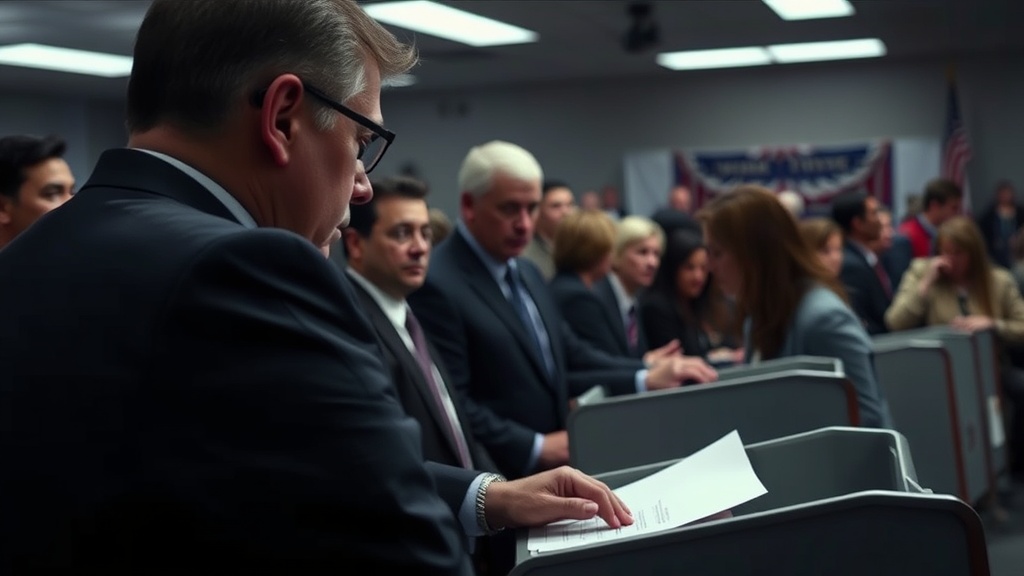
Election Officials on Edge Amid Trump's Push to Nationalize Voting Process
Trump's demand to nationalize elections raises fears among officials as midterms approach, prompting preparations for potential federal involvement.

In recent statements, former President Donald Trump has reignited a contentious debate surrounding the federal government’s role in elections, calling for the nationalization of voting processes in the United States. This unprecedented demand has sent ripples through the political landscape, leading state and local election officials to brace for a tumultuous election year ahead. As the midterm elections approach, concerns are mounting over how these calls may impact the integrity and administration of elections at the state level.
During a podcast appearance, Trump suggested that Republicans should exert federal control over voting operations in at least 15 states, although he did not specify which states he was referring to. He reiterated this sentiment in a subsequent press conference, asserting that states are merely “agents” of the federal government when it comes to managing elections. “I don’t know why the federal government doesn’t do them anyway,” Trump remarked, a statement that contradicts the U.S. Constitution, which grants states the authority to oversee their own election processes.
State officials across the country are wary of the implications of Trump’s rhetoric. Oregon Secretary of State Tobias Read expressed his concerns during an interview, stating, “I don’t think we can put anything past this administration. They are increasingly desperate about what’s going to happen when they are held accountable by American voters.” This apprehension is palpable among election officials who are gearing up for November’s midterms, which are pivotal for control of Congress.
The Trump administration has made several attempts to influence state-run elections, most notably through an executive order last March that required voters to prove their citizenship to participate in federal elections. This directive sparked outrage, as it is widely viewed as an overreach of federal authority into an area traditionally managed by the states. The Constitution clearly delineates the responsibility of conducting elections to the states, allowing Congress to make modifications only within the framework established by state law.
In light of the recent federal actions, election officials are re-evaluating their protocols in anticipation of potential federal involvement. Concerns are particularly high regarding the presence of federal law enforcement at polling places, which could disrupt the voting process. “It definitely factors into our planning,” remarked Scott McDonell, the Democratic clerk in Dane County, Wisconsin, suggesting that local officials are contemplating various responses to possible federal interventions.
Democratic officials are not the only ones voicing concerns; some Republicans have also expressed disapproval of Trump’s nationalization push. Missouri Secretary of State Denny Hoskins, a Republican, stated that he does not support the idea of federalizing elections, emphasizing the long-standing conservative principle of state control over such matters. Georgia Secretary of State Brad Raffensperger echoed this sentiment, emphasizing the need for strengthening state election administration rather than federal oversight.
The potential consequences of federal involvement extend beyond administrative concerns. Critics argue that nationalizing elections could lead to violations of the Constitution and undermine the public’s trust in the electoral process. U.S. District Court Judge David O. Carter recently highlighted the dangers of such actions, noting that the erosion of democratic principles occurs gradually, warning that the current political climate poses a threat to the integrity of elections.
In several states, election officials are actively preparing for a range of scenarios, including the potential for federal agents to be present at polling locations. Ingham County Clerk Barb Byrum has indicated that election administrators are conducting tabletop exercises to prepare for numerous contingencies, which now include federal interference in elections. “We will be prepared. Voters will hopefully not see anything different at their polling locations,” Byrum stated, emphasizing the need to remain vigilant in protecting the electoral process.
Moreover, the U.S. Department of Justice has recently intensified its efforts to acquire unredacted voter rolls from states, leading to further tensions between state officials and the federal government. The Justice Department’s insistence on obtaining sensitive voter information has raised significant privacy concerns among election officials, as many fear that such data could be misused to disqualify eligible voters or challenge election outcomes.
As election officials grapple with these developments, they are also bolstered by networks of legal support, with organizations like the Center for Election Innovation & Research preparing thousands of lawyers to provide pro bono assistance to election officials facing legal challenges. This collaborative effort is crucial in ensuring that the electoral process remains free from undue influence.
With the midterm elections fast approaching, the stakes are high for both sides of the political spectrum. Trump’s calls for nationalization have prompted a wave of responses from officials across the country, highlighting a growing divide over the future of election administration in the United States. As the nation prepares to vote, the implications of these federal and state confrontations will likely be felt long after the ballots are cast, potentially reshaping the landscape of American democracy for years to come.